
Relations between Vietnam and Italy are strengthened by the complementary nature of the two economies.
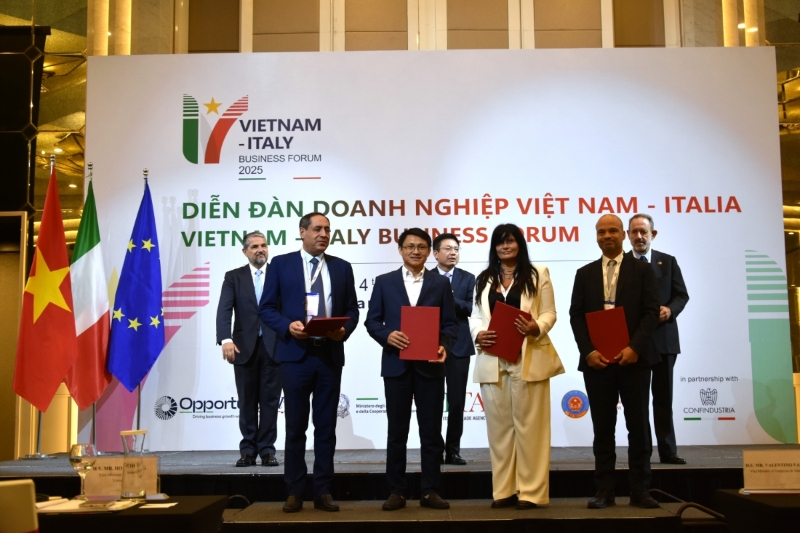 The Vietnam – Italia Business Forum 2025 held in Hanoi.
Italy is recognized as one of the most advanced economies in the EU, characterized by a dynamic network of small and medium-sized enterprises (SMEs) equipped with advanced technologies and innovative capabilities – assets that align closely with Vietnam’s industrial development priorities.
It currently stands as one of Vietnam’s most important partners in Europe. Over many years, Italian enterprises have proactively broadened their market presence in Vietnam, intensified investment activities, and deepened cooperation.
Drawing attention
Vietnam offers a stable and increasingly transparent investment environment, a large and skilled workforce, and a strategic location in the heart of Southeast Asia, making it an attractive destination for Italian businesses seeking to expand markets, optimize production networks, and benefit from preferential access provided by free trade agreements, particularly the EU-Vietnam Free Trade Agreement (EUVFTA).
Data from the Foreign Investment Agency (FIA) at the Ministry of Finance (MoF) shows that, as of October, Italian investors had 163 active projects in Vietnam with total registered capital of some $629.25 million. Several major Italian companies, such as Piaggio, Ariston Thermo, and Mapei, have chosen Vietnam as their primary manufacturing base for the entire Asian region. The activities of Italian investors reflect Italy’s steady and long-term presence in Vietnam’s investment landscape, demonstrating not only the interest of Italian businesses in the market but also the growing confidence they place in Vietnam’s economic prospects, reform efforts, and investment environment.
Bilateral trade reached more than $6.91 billion in 2024, an increase of 13.1 per cent compared to 2023, and surpassed $6.08 billion in the first ten months of this year; maintaining a stable upwards trend. These figures demonstrate that economic relations between Vietnam and Italy are developing steadily and hold significant potential for further expansion in the years ahead.
Beyond economic cooperation, the relationship is also enriched by shared cultural and historical values, as well as a mutual aspiration for peace, stability, and sustainable prosperity. These common foundations help foster deeper understanding between the two peoples and create a favorable environment for long-term collaboration across multiple fields.
Notably, bilateral relations between the two have posted a host of remarkable accomplishments, becoming one of the most prominent examples of Vietnam’s cooperation with European countries. These factors serve as an important foundation for the two to continue elevating their partnership to new heights. “The Vietnam-Italy relationship is strengthened by four complementary similarities: mutual trust; economic structures that support and promote each other’s development; a warm and sincere friendship; and a shared desire for peace and strong advancement,” Deputy Minister of Finance Ho Sy Hung emphasized.
Beyond appreciating the strong political ties, Italian businesses also view Vietnam as a market full of potential. Mr. Fabio De Cillis, Director of the Italian Trade Agency (ITA) in Vietnam, noted that Vietnam has been emerging as an attractive destination in the internationalization strategies of Italian enterprises thanks to its dynamic growth, skilled workforce, and continually-improving investment environment.
Economic cooperation between the two countries, particularly in machinery and equipment, has also been expanding rapidly. Italy not only exports complete machinery but also collaborates with Vietnam in supplying components and semi-finished products and in technology transfer, thereby fostering a mutually-beneficial cooperative model and enabling Vietnam to gradually integrate more deeply into global supply chains. “In addition to traditional strengths such as food and fashion, Italy is also interested in developing cooperation with Vietnam in new sectors of potential such as high technology, including medical technology, space technology, and AI,” Mr. De Cillis added.
Untapped potential
In addition to the positive results achieved over many years of cooperation, ties in economics, trade, and investment between Vietnam and Italy still hold tremendous untapped potential for further development. The two countries possess a wide range of complementary advantages, from economic structures and sectoral strengths to geopolitical positions, which open numerous opportunities for businesses on both sides to strengthen connections, expand investment projects, boost import-export activities, and promote technology transfer.
In order to more strongly and effectively harness this potential, Deputy Minister Hung noted that Vietnam hopes Italian enterprises, drawing on their experience, resources, and reputation, will support Vietnam in accessing shifting investment flows, green and sustainable finance, and capital for science, technology, and innovation. “In particular, to realize Vietnam’s commitment to achieving net-zero emissions by 2050, Vietnam looks forward to learning from Italy’s experience and cooperating in the development of renewable energy and the green economy,” he stressed.
Beyond cooperation at the national level, collaborative opportunities between localities in Vietnam and Italy are also more promising than ever. As regional authorities and localities on both sides strengthen exchanges and seek practical partnership models, new avenues for cooperation in areas such as investment, tourism, education, culture, and urban development are rapidly emerging. These growing local-to-local ties add depth and vitality to the overall bilateral relationship.
One significant turning point was the inauguration of direct Hanoi – Milan flights earlier this July, shortening travel times and facilitating trade, tourism, and business connections. As a result, opportunities for economic cooperation, investment, and exchanges between localities in both countries expanded markedly, increasing the likelihood of forming new partnership projects across multiple sectors.
Furthermore, the effective utilization of the EUVFTA has been creating an important driving force for the strong and continued growth of Vietnam-Italy economic cooperation. Extensive tariff-reduction commitments offer major opportunities for Vietnamese goods to access the European market, while enabling Italian companies to more easily reach Vietnam’s highly promising market.
The EUVFTA also enhances the harmonization of standards and technical regulations, improves the investment and business environment, and enables firms from both sides to expand production, strengthen supply chain links, and promote projects of high complementarity. Consequently, Vietnam-Italy trade and investment relations are not only increasing in scale but also improving significantly in quality, moving towards long-term sustainability and effectiveness.
Mr. Valentino Valentini, Deputy Minister for Enterprises and Made in Italy, said that in a rapidly-changing global landscape, both Italy and Vietnam need to focus on key areas such as digital technology, green technology, energy, and AI, while addressing challenges related to energy balance, particularly the imperative to “advance economic development while minimizing environmental impacts.”
Therefore, the two countries’ cooperation and mutual support in overcoming these challenges will open up numerous opportunities to boost trade, attract high-quality investment, accelerate technology transfer, and develop high value added supply chains. “Italian businesses are increasingly interested in the Vietnamese market and stand ready to share their experience to help address these challenges,” Mr. Valentini affirmed.