
Geopolitical Synergies: Driving Regional Growth Through the Vietnam-Singapore Comprehensive Strategic Partnership
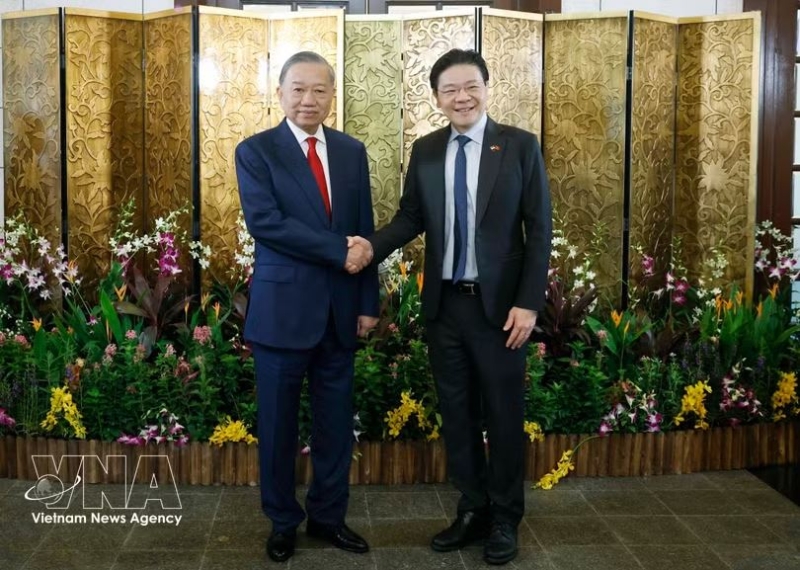
Strategic alignments between leading nations serve as critical anchors for regional stability and sustainable development. Recently, this geopolitical dynamic reached a historic high point during an official state visit to Singapore. General Secretary and State President To Lam held high-level talks with Singaporean Prime Minister Lawrence Wong. Consequently, the two leaders reached a comprehensive consensus to enhance bilateral cooperation mechanisms. This decision breathes fresh operational momentum into the newly upgraded Vietnam-Singapore Comprehensive Strategic Partnership.
The summit emphasized mutual trust and shared forward-looking economic models. Therefore, for regional business executives and institutional investors, this high-level diplomatic milestone outlines a clear roadmap. It creates next-generation market opportunities spanning technology, clean energy, and logistics connectivity.
Pioneering a Growth Model Driven by the Digital and Green Economy
During the official discussions, Singaporean Prime Minister Lawrence Wong warmly congratulated President To Lam on his election. Additionally, the Singaporean leader expressed immense admiration for Vietnam’s recent socio-economic achievements. Vietnam is actively accelerating an intensive administrative reform program to match shifting global paradigms. Specifically, the nation is fully determined to transition into a sophisticated growth model. This model relies heavily on the knowledge economy.
Strategic Tech Transformation
President To Lam highlighted science, technology, innovation, and digital transformation as the foundational drivers of Vietnam’s future. Indeed, both nations now designate these advanced domains as top-tier priorities for international collaboration. Furthermore, Singapore provides technical guidance to operate Vietnam’s national data center. Singaporean experts also assist in establishing cutting-edge artificial intelligence (AI) and high-performance computing centers.
Both sides enthusiastically welcomed the upcoming Vietnam–Singapore Technology Connectivity Forum to ensure these initiatives become highly substantive. In addition, this initiative will form a robust, cross-border science and technology ecosystem. This network gives global tech enterprises a highly stable environment to deploy high-value innovations.
Expanding Industrial Footprints and Supply Chain Resilience
The economic foundations of this partnership remain exceptionally robust. Two-way trade volumes reached nearly $12 billion in 2025. Currently, Singapore stands proudly as the second-largest foreign investor in Vietnam. The city-state boasts an impressive cumulative registered investment capital of nearly $100 billion. Undoubtedly, the highly successful Vietnam–Singapore Industrial Park (VSIP) framework serves as the crown jewel of this financial alliance.
Next-Generation Industrial Hubs
Marking three decades of uninterrupted operational success, the two nations are aggressively expanding this initiative. They plan to lift the total number of VSIPs to 30 in 2026. Simultaneously, developers will explicitly link these new-generation industrial hubs with high-technology transfers and clean energy integration. As a result, the leaders directly witnessed the official exchange of new investment certificates. These certificates fund critical VSIP projects located in Hue, Nghe An, Ninh Binh, and Hai Phong.
The bilateral commitment heavily prioritizes bolstering maritime and aviation supply chain resilience. To achieve this, customized partnerships will focus directly on food security and carbon credit exchanges. These projects will also accelerate clean energy connectivity and build an elite international financial center.
Multilateral Commitments and Regional Maritime Stability
The strategic value of this comprehensive partnership extends far beyond bilateral commercial transactions. Fortunately, both nations maintain a highly synchronized stance across prominent multilateral platforms. They cooperate actively within the United Nations and the Association of Southeast Asian Nations (ASEAN). As the region prepares for future geopolitical shifts, Vietnam pledges full support to Singapore. This assistance will help Singapore successfully fulfill its rotating role as the Chair of ASEAN in 2027.
Regarding regional security, both leaders firmly reaffirmed the critical importance of maintaining absolute peace in the East Sea (South China Sea). They insist on protecting safety and freedom of navigation and overflight. Consequently, they explicitly called for the peaceful settlement of international disputes. They reject the threat or use of force. In the long run, nations must resolve all maritime differences via peaceful measures. These measures must follow recognized international law, including the landmark 1982 United Nations Convention on the Law of the Sea (UNCLOS 1982).
In conclusion, this historic diplomatic engagement firmly cements a prosperous era of mutual development. For multinational corporations looking to scale operations, this solidified alliance offers an unparalleled legal and infrastructural anchor in Southeast Asia.