
Bắc Ninh has officially achieved a historic milestone. It has successfully risen from rural origins to become Vietnam’s premier high-tech industrial hub. Consequently, the province has secured the number one position nationwide for Bac Ninh exports. This signals a significant shift. Now, quantity is effectively matched by quality, value addition, and long-term competitiveness.
A Journey from Rural Roots to Industrial Powerhouse
The ascent of Bac Ninh exports resulted from a persistent, multi-decade strategy. Initially, in 1997, the province laid the groundwork by developing industrial parks like Quế Võ and Tiên Sơn. This shifted the local economic structure toward industry and services. Moreover, after 2006, Vietnam joined the WTO. This opened doors for high-tech electronics projects from Japan, South Korea, and Taiwan.
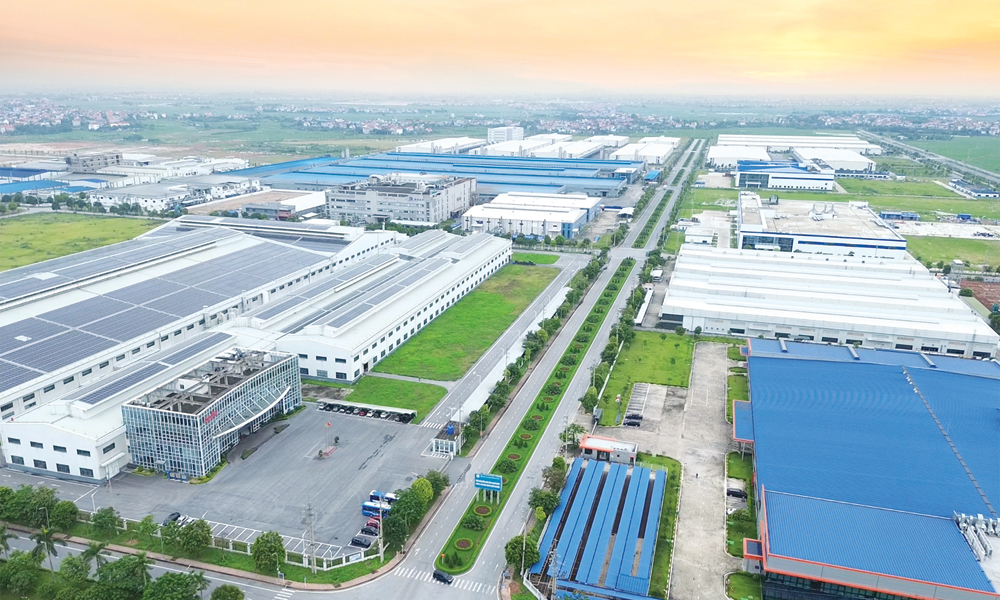
Hoa Lu industrial Park
The pivotal “giant” shift occurred between 2008 and 2020. Samsung selected Yên Phong Industrial Park for its first mobile phone factory in Vietnam. This investment acted as a catalyst. It attracted a network of multinational corporations. As noted by the General Department of Vietnam Customs, the province’s ability to integrate into global supply chains has been the fundamental driver of its economic success.
What Drives the Record-Breaking Bac Ninh Exports
The current dominance of Bac Ninh exports is rooted in a diversified industrial base. Currently, 43 of 52 planned industrial zones are active. Furthermore, the province hosts nearly 3,390 FDI projects from 42 countries.
In 2025, the province set a record for total import-export turnover at $182 billion. This accounts for 20.2% of the national total. Additionally, export value reached approximately $94 billion, marking a 36.1% increase year-on-year.
The core drivers of this growth include:
-
High-Value Technology: Companies like Samsung, Canon, Amkor, and Foxconn utilize the province as a global export base for electronics. Samsung alone is responsible for roughly 70% of local exports.
-
Strategic Adaptation: The province implemented policies to diversify markets. Consequently, it surpassed Ho Chi Minh City in monthly export volume starting in July 2025.
-
Global Connectivity: Local businesses are integrating into the global value chain. For instance, the Samsung-supported smart factory initiative has bolstered local competitiveness.
Future Strategies for Sustainable Growth
As the province moves beyond simple growth rates, the focus of Bac Ninh exports is shifting. Therefore, it is moving toward sustainability and deeper value chain participation. According to the Vietnam Chamber of Commerce and Industry (VCCI), the future of regional trade depends on strict adherence to green standards.
Shutterstock
To maintain its lead, provincial authorities are prioritizing three key areas:
-
Administrative Reform: They are streamlining procedures to support enterprises and leverage Free Trade Agreements (FTAs).
-
Local Integration: Authorities are encouraging collaboration between FDI giants and domestic companies. This helps optimize local production capabilities.
-
Quality Upgrading: Businesses are shifting from assembly-based manufacturing to higher-value technological processes. Thus, Bac Ninh exports will remain competitive in an era of rapid trade volatility.
In summary, the trajectory of Bac Ninh exports reflects the modernization of Vietnam’s entire industrial sector. By focusing on smart manufacturing and high-value integration, Bac Ninh is well-positioned to maintain its status as the nation’s premier export leader.