
Vietnam has officially solidified its position as the Republic of Korea’s (RoK) primary export hub within ASEAN. As Seoul seeks to diversify its trade portfolio and reduce reliance on traditional giants like the US and China, the economic synergy between these two nations has reached new heights.
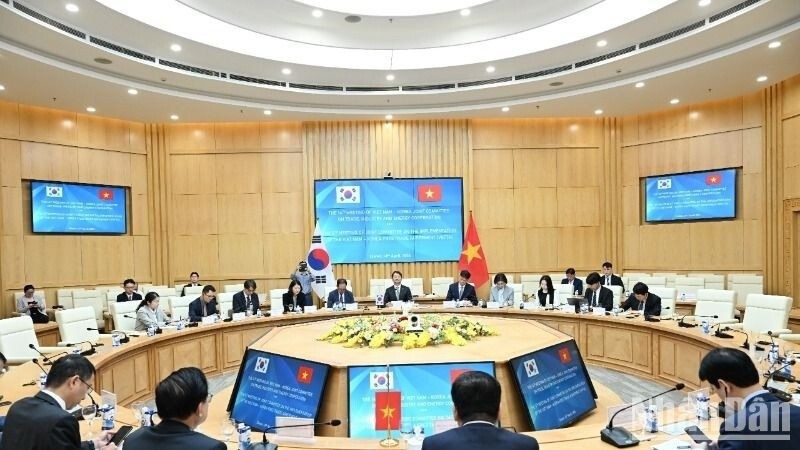
At a session of the Vietnam-RoK Joint Committee on Trade, Industry and Energy Cooperation in April, 2025 in Hanoi. (Photo: nhandan.vn)
A Breakdown of South Korea Exports to Vietnam Growth
According to the latest data from the RoK’s Ministry of Trade, Industry and Energy and the Korea International Trade Association (KITA), South Korea exports to Vietnam rose 7.6% in 2025, reaching a total of $62.8 billion. Simultaneously, imports from Vietnam climbed 11.7% to $31.8 billion.
This surge brought two-way trade to $94.5 billion, representing nearly 35% of the RoK’s trade with China. By growth rate, Vietnam ranked second among Korea’s global markets, trailing only Taiwan. This trajectory confirms that the strategic partnership is no longer just about labor-intensive goods, but high-tech integration.
The Role of Semiconductors and High-Tech Trade
The primary engine behind the 2025 figures is the semiconductor industry. Driven by the global AI boom and data-center investments, chips have become the cornerstone of South Korea exports to Vietnam. In 2025 alone, semiconductor turnover in Vietnam hit $24.7 billion—a staggering 36.7% jump from the previous year.
Since the establishment of diplomatic ties in 1992, bilateral trade has exploded 190-fold. The trade structure is highly complementary: the RoK exports intermediate goods and technology to factories in Vietnam, which then process these into finished products for the global market.
Samsung and the Future of Bilateral Relations
A significant portion of the trade volume is driven by major players like Samsung Electronics. Currently, Samsung produces over 50% of its global smartphone output in Vietnam, accounting for approximately 20% of the country’s total exports. The opening of a major R&D center in Hanoi in 2022 further signals a shift toward high-value research and development.
Beyond electronics, the “Korean Wave” continues to influence the market, with K-beauty and K-food products posting consistent growth. For more insights on regional trade standards, you can visit the World Trade Organization (WTO) website.
Internally, this growth aligns with Vietnam’s goals to modernize its industrial base. To see how this impacts local manufacturing, check out our previous report on [Vietnam’s Industrial Growth Trends].